

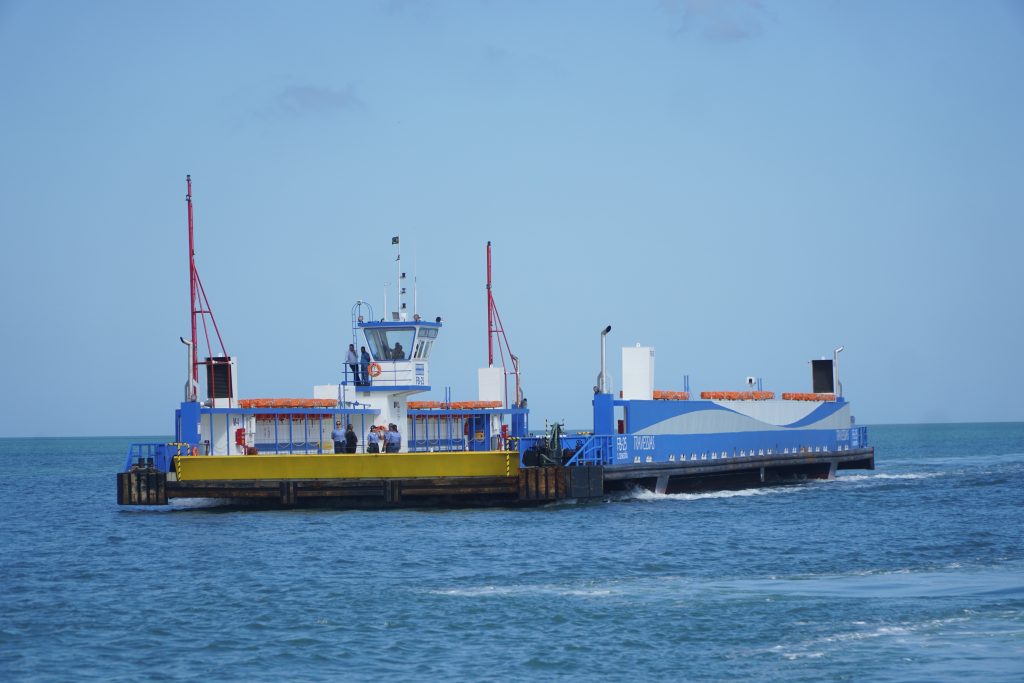
The concession project for the waterway crossing system of the State of São Paulo foresees over R$ 1 billion in investments to expand the capacity of the vessel fleet, floating docks, and various improvements in land-based infrastructure, such as the construction of new terminals and renovations of existing ones. The modernization will bring more efficient operations and higher quality in public transportation services offered to the population.
In the first year of the concession, expected to begin under private operation in 2026, the current diesel-powered vessels will be replaced with new vessels converted to electric propulsion, in locations where operations and infrastructure allow. The expectation is that all vessels will be replaced by the sixth year of the public-private partnership contract.
Modern transport with greater capacity for vehicles and passengers will result in more efficient service operations and shorter waiting times, creating a faster and more satisfactory experience for users. “It is obvious that the main concern today is reducing wait times in ferry lines for users in the central, northern, and southern coastal regions. Vessels with a capacity of up to 70 vehicles will be acquired, significantly reducing passenger wait times,” emphasized Edgard Benozatti, president of Companhia Paulista de Parcerias (CPP).
On land, new terminals will be installed or existing ones renovated, with all necessary infrastructure for boarding and disembarking, providing a more comfortable environment for users. “As investments are made, users will see the improvements,” said the CPP president.
Qualified under the São Paulo State Partnership Program (PPI-SP), the concession includes the operation, maintenance, and management of 14 waterway lines, including eight coastal routes (operated by the State Department of Waterways in the northern, central, and southern coastal regions), three ferry routes operated by the Metropolitan Water and Energy Company, and three on the Paraibuna Reservoir.
The 14 lines included in the concession are: São Sebastião–Ilhabela, Santos–Vicente de Carvalho, Santos–Guarujá, Bertioga–Guarujá, Cananéia–Continente, Cananéia–Ilha Comprida, Cananéia–Ariri, Iguape–Juréia, Bororé–Grajaú, Taquacetuba–Bororé, João Basso–Taquacetuba, Porto Paraitinga, Porto Varginha, and Porto Natividade da Serra.
Currently, the system serves around 11 million passengers and 10 million vehicles annually.
The public notice is expected to be published in the first half of 2025, with the auction and contract signing scheduled for the second half of 2025. It will be a single contract covering all crossings in the state. The sponsored concession (PPP) model will have a 20-year term.
State Partnership Program (PPI)
The PPI-SP is an initiative by the State Government to expand investment opportunities, employment, and socioeconomic, technological, environmental, and industrial development in São Paulo.
Focusing on the areas of highways, mobility, social infrastructure, and water/energy, PPI-SP is implementing the largest and most comprehensive private investment program in the history of São Paulo, benefiting the population and driving regional economic growth. In total, 29 projects have already been qualified, representing a portfolio of more than R$ 494 billion.
Photo: Governo de SP