

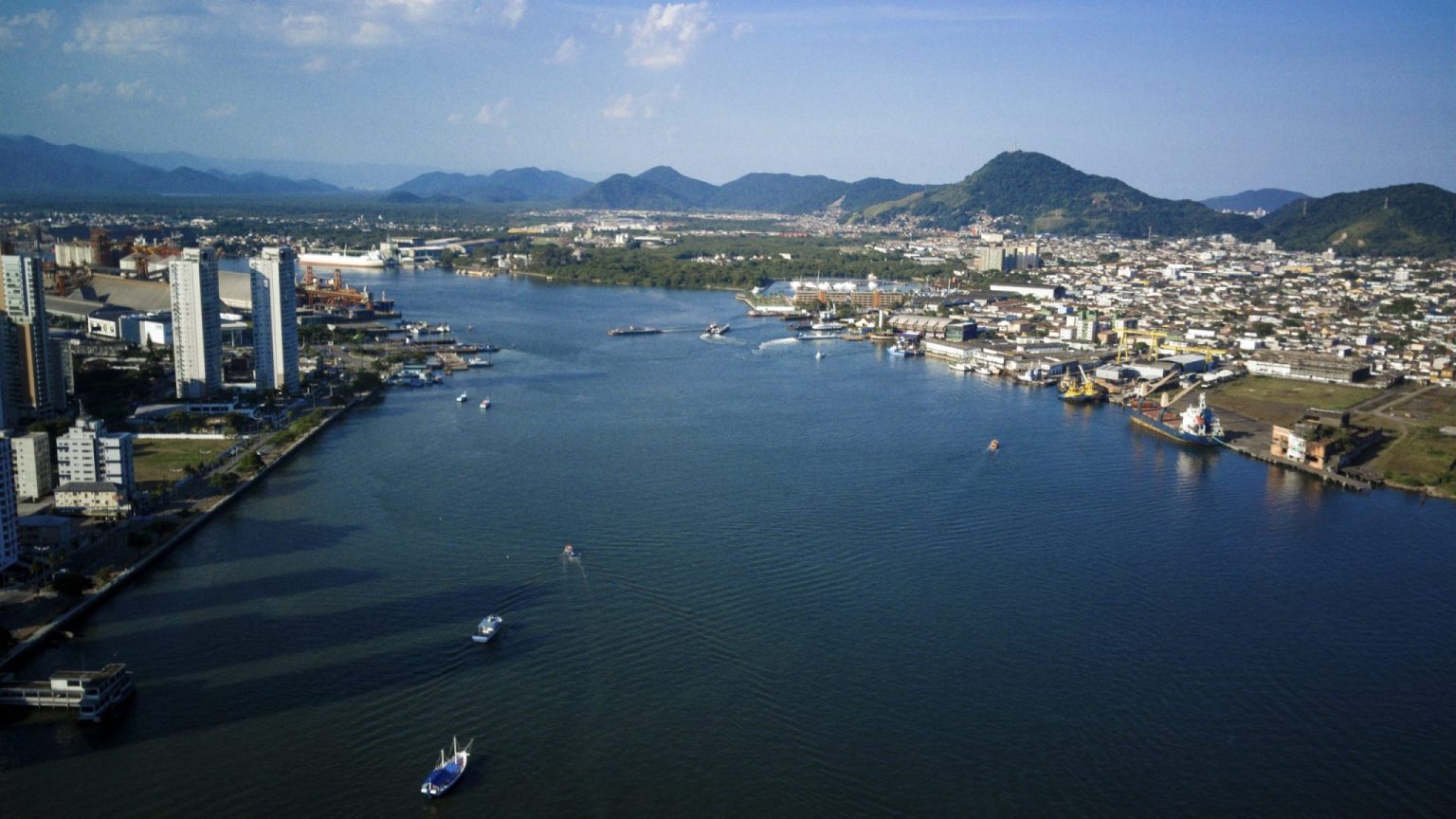
During an international mission to Europe, the government of São Paulo is promoting Brazil’s first immersed tunnel, which will be built between the towns of Santos and Guarujá. The project uses internationally renowned technology, applied in countries such as the Netherlands, Japan, China and South Korea.
The structure will be 1.5 km long, with 870 meters submerged, and will use the immersed tunnel method, a modern alternative to traditional deep excavation models or suspension bridges.
Unlike excavated tunnels – such as those used in the metro – the immersed tunnel will be made up of precast concrete modules, built in a dry dock. These modules will then be transported by floatation to the site, where they will be submerged with precision, embedded in the channel bed and anchored with layers of ballast.
The choice of this method took into account a number of technical and operational factors.
The region’s soil, made up of soft clays and river sediments, does not offer the stability required for deep excavations. In addition, the construction of a bridge was ruled out due to restrictions imposed by the Santos Air Base and heavy ship traffic in the port channel.
The submerged tunnel also offers environmental and urban advantages. It requires less expropriation, is faster to build and reduces the impact on the landscape and urban surroundings.
From the point of view of operation and maintenance, the solution is also more efficient. The model has lower costs throughout the concession contract and offers easier access for technical maintenance when necessary.
The project includes three lanes per direction, one of which is adaptable to the Light Rail Vehicle (LRV), and an exclusive central gallery for pedestrians and cyclists, equipped with ventilation, lighting and security systems.
The structure will have advanced real-time monitoring systems, intelligent traffic control and integrated safety mechanisms, guaranteeing continuous and efficient operation in any situation.
The adoption of the immersed tunnel model marks an unprecedented technological advance in Brazil and could serve as a benchmark for future projects in coastal regions with similar characteristics. The Santos-Guarujá Tunnel reaffirms the role of the State of São Paulo in leading infrastructure engineering in Latin America.