

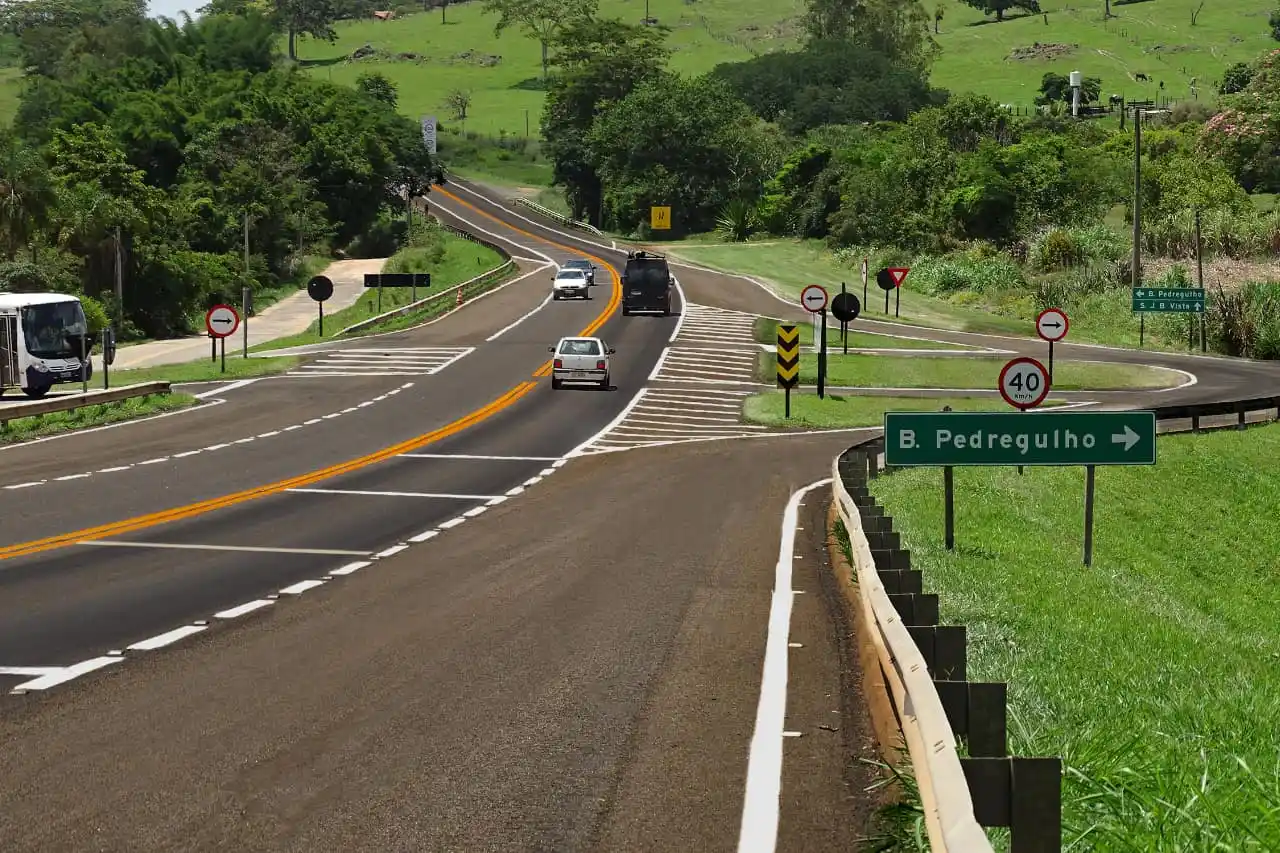
The Government of São Paulo held this Friday (27), at the headquarters of B3 (São Paulo Stock Exchange), the auction for the Rota Mogiana Highway Concession, focused on the modernization and expansion of highways. The Rota Mogiana consortium was declared the winner, submitting the highest fixed grant payment to the State, in the amount of R$ 1.08 billion. The winning bid represented a 187% premium over the minimum grant amount, set at R$ 580,000, and surpassed the other three bidders: MC Brazil Concessões Rodoviárias (R$ 1.01 billion), EPR Participações (R$ 560 million), and Motiva Infraestrutura de Mobilidade (R$ 180.2 million).
The concessionaire will be responsible for operating, maintaining, and expanding the highway system over the next 30 years. The new concession, which consolidates stretches currently managed by Renovias as well as highways administered by DER (Department of Highways), is scheduled to begin in July 2026, when the current contract expires.
Covering 520 kilometers, the concession provides for R$ 9.4 billion in investments throughout the contract, including duplications, third lanes, frontage roads, shoulders, pedestrian overpasses, access interchanges, bypasses, and bike paths. The project incorporates sections currently under the Renovias concession, as well as highways managed by DER, establishing a broad set of works aimed at increasing capacity and improving traffic conditions.
“These interventions will be important for tourism, for our coffee and wine routes, and for our water production. This is a contract that will make a difference. Over time, we have built the best infrastructure in Brazil, and we cannot stop. We are reaching the end of the Renovias contract and needed not only a new bid to replace it, but something that would solve long-standing issues,” said Governor Tarcísio de Freitas.
The change will bring immediate benefits, including reductions in toll rates. In Jaguariúna, tolls will drop by up to 29%. There will also be reductions of 27% in Águas da Prata, 26% in Estiva Gerbi, and 20% in Espírito Santo do Pinhal and Itobi, as well as reductions in Casa Branca (13%), Mococa (9%), and Aguaí (5%). As a result, most existing toll plazas will see an immediate decrease in base toll rates at the start of operations. The measure is part of the State’s policy to standardize per-kilometer toll rates, ensuring lower per-km charges and greater fairness for users.
The initiative has the potential to generate approximately 11,000 direct and indirect jobs and consolidates an important regional integration corridor, connecting the Campinas Metropolitan Region to Ribeirão Preto and municipalities near the Minas Gerais border. The project enhances road safety, improves traffic flow, and strengthens integration among strategic agricultural, industrial, logistics, and tourism hubs for São Paulo’s economy.
Planned works include the duplication of more than 217 kilometers on strategic highways, such as SP-350 between Casa Branca and São José do Rio Pardo; SP-344 between São João da Boa Vista and Vargem Grande do Sul; SP-333 and SP-338 linking Mococa to Cajuru; SP-340 connecting Mococa to the Minas Gerais border; and SP-107 between Santo Antônio de Posse and Artur Nogueira.
Additionally, 86 kilometers of new frontage roads and 138 kilometers of additional lanes are planned, benefiting major corridors such as SP-340 between Campinas and Mogi Guaçu. In Águas da Prata, the plan includes duplication up to the Minas Gerais border and the construction of a new urban bypass on SP-342, removing heavy traffic from the city center and addressing a long-standing community demand.
To enhance urban access and ensure greater user safety, the project incorporates improvements based on public consultation contributions. The scope now includes 58 new pedestrian overpasses, 129 new interchanges and local roads, expanding connectivity between highways and urban centers and reinforcing user safety.
Specific safety measures are also planned, including installation of barriers and guardrails, rumble strips in high-traffic sections to alert drivers, and modernization of road signage and lighting, especially at critical points.
Approximately 2.3 million people across 22 municipalities are expected to benefit, including Aguaí, Águas da Prata, Artur Nogueira, Cajuru, Campinas, Casa Branca, Cosmópolis, Espírito Santo do Pinhal, Estiva Gerbi, Holambra, Itobi, Jaguariúna, Limeira, Mococa, Mogi Guaçu, Mogi Mirim, Santa Cruz da Esperança, Santo Antônio de Posse, São João da Boa Vista, São José do Rio Pardo, Tapiratiba, and Vargem Grande do Sul.
The interventions will reduce travel times, improve traffic flow, and generate direct gains for regional production chains by facilitating agricultural transport, lowering logistics costs, and enhancing road safety. “Rota Mogiana is a structuring project for the interior of the state, expanding regional integration and stimulating job creation and opportunities,” said Rafael Benini, Secretary of Partnerships and Investments.
“Today we celebrate the victory of this auction, which carries historic responsibility. Winning Rota Mogiana means taking responsibility for some of the most relevant stretches in the State of São Paulo—a corridor that connects prosperous cities and integrates agribusiness, industry, and tourism,” said Igor Jefferson Lima Clemente, representative of the winning consortium.
During the bidding process, the project included broad public participation. Public consultations and hearings incorporated contributions from society, municipal authorities, and sector stakeholders, resulting in a more balanced, secure, and efficient contractual model for users. A total of 284 contributions were analyzed by technical teams from SPI and Artesp and incorporated into the final bidding documents, respecting regional demands and focusing on safety, traffic flow, and service quality.
Siga Fácil
Rota Mogiana is part of the new round of the São Paulo State Highway Concessions Program, which adopts the Siga Fácil electronic toll system. Traditional toll plazas are replaced by intelligent electronic gantries that identify vehicles by license plates or tags, improving traffic flow and ensuring fairer toll charges. Under Siga Fácil, drivers pay only for the distance traveled.
In addition to modernizing the toll collection model, the concession begins with reductions in existing base toll rates, in line with the State’s per-kilometer standardization policy, which establishes lower per-km charges and proportional billing based on usage.
Supervised by the São Paulo State Transport Agency (Artesp), the system eliminates queues and reduces accidents. It will be gradually implemented in recent concession projects such as Novo Litoral Paulista, Nova Raposo, and Rota Sorocabana, as well as in existing contracts. The website sigafacil.sp.gov.br provides a map of gantries, payment methods, and customer service channels.
São Paulo highways among the best in the country
According to the latest Highway Survey by the National Transport Confederation (CNT), 14 of the 20 highest-rated highways in Brazil are located in São Paulo, with 11 under concession. The survey considers criteria such as pavement quality, signage, and road geometry, reinforcing the State’s leadership in road safety and operational efficiency.
SP pra Toda Obra
The project is part of the SP pra Toda Obra program, a Government of São Paulo initiative that provides improvements across 21,200 kilometers of highways managed by the São Paulo State Department of Highways (DER-SP) and concessionaires, under Artesp supervision. The R$ 30.5 billion investment is the largest in the State’s history in this segment.