

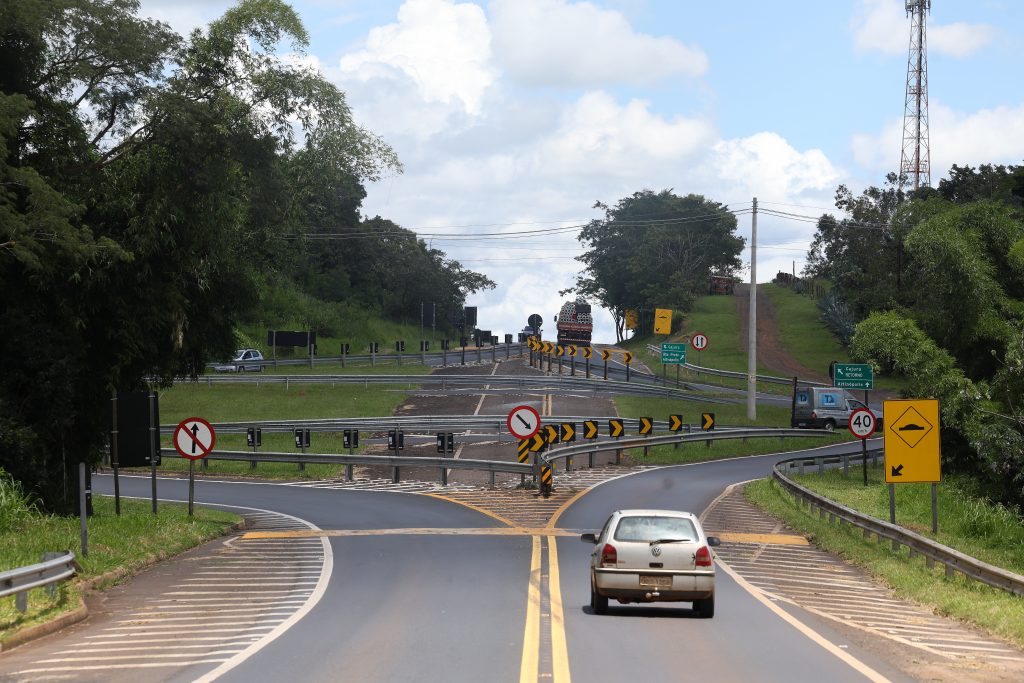
The concession of the Rota Mogiana highway network by the Government of São Paulo, through the Secretariat of Partnerships and Investments (SPI), will modernize, operate, and expand more than 500 kilometers of strategic highways in the countryside of São Paulo. The project will facilitate the transport of agricultural production from the Alta Mogiana region toward the border with Minas Gerais and the Campinas Metropolitan Region, connecting these areas to important production, tourism, and logistics hubs across the State. The consortium led by the Azevedo & Travassos group won the auction by offering the highest fixed concession payment to the State, totaling R$ 1.08 billion.
The Alta Mogiana region stands out for producing agricultural commodities that are important to Brazil’s export portfolio, such as coffee and sugar. The São João da Boa Vista–São José do Rio Pardo–Espírito Santo do Pinhal corridor has consolidated itself as a “terroir” for the export of specialty coffee and agricultural commodities, where value is added through certification of origin, sensory quality, and post-harvest processing. According to Brazil’s Foreign Trade Chamber, the main destinations for coffee produced in this region include demanding markets such as Germany, Italy, the United States, Japan, and the Netherlands. The added value is largely intangible: the product sold carries the history, origin, and sensory profile of the coffee bean.
With a 30-year contract and estimated investments of R$ 9.4 billion, the concession was structured through an extensive technical process that incorporated contributions from society, municipal managers, and sector stakeholders, resulting in a model that is more balanced, secure, and efficient for users.
Investments and expansion of road capacity
The project establishes a broad set of works aimed at expanding road capacity and improving traffic conditions. During the concession period, 217 kilometers of highway duplications, 138 kilometers of additional lanes, and 86 kilometers of new marginal roads are planned, in addition to the implementation of more than 140 kilometers of shoulders, especially in critical sections for emergency response and maintenance operations.
The project also includes 58 new pedestrian overpasses and 129 access interchanges, as well as remodeled intersections and bus stops. A new bypass in Águas da Prata will remove heavy traffic from the urban center and address a long-standing demand from the local population.
The Rota Mogiana project was designed so that benefits reach the population in the early years of the contract, with a schedule that prioritizes highway duplications, additional lanes, and operational improvements in corridors with higher traffic volumes and logistical relevance.
In addition to physical infrastructure works, the contract includes modernization of highway operations, with continuous monitoring, 24-hour assistance, communication systems for users, and rapid emergency response, raising the standard of service from the beginning of the concession.
The concession is expected to benefit approximately 2.3 million people across 22 municipalities, including Aguaí, Águas da Prata, Artur Nogueira, Cajuru, Campinas, Casa Branca, Cosmópolis, Espírito Santo do Pinhal, Estiva Gerbi, Holambra, Itobi, Jaguariúna, Limeira, Mococa, Mogi Guaçu, Mogi Mirim, Santa Cruz da Esperança, Santo Antônio de Posse, São João da Boa Vista, São José do Rio Pardo, Tapiratiba, and Vargem Grande do Sul.
A modern concession model
Rota Mogiana is part of the new round of the São Paulo State Highway Concessions Program, which combines stretches under public and private administration, with much of the revenue coming from toll plazas already in operation. The model adopts the electronic tolling system Siga Fácil, which allows proportional charging based on the distance traveled, promoting greater fairness in toll pricing and smoother traffic flow.
The project reaffirms the commitment of the Government of São Paulo to a modern, efficient, and user-oriented infrastructure model aligned with national and international best practices.