

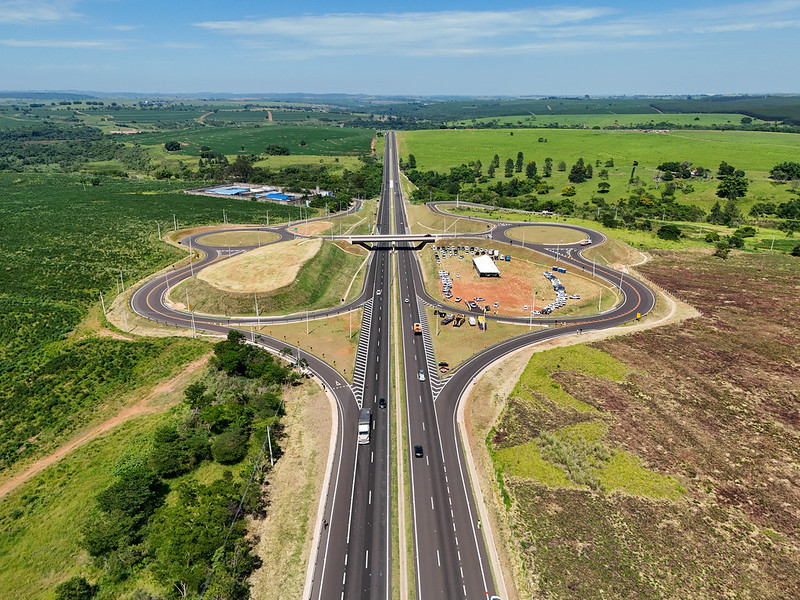
The Rota Mogiana concession, carried out by the Government of São Paulo under the State Highway Concessions Program, represents a strategic step forward for tourism and socio-economic development in the countryside of São Paulo. The upgrading of the road network consolidates an important regional integration corridor, connecting the Campinas Metropolitan Region to municipalities up to the border with the State of Minas Gerais, expanding access to tourist, historical, and cultural destinations that are part of São Paulo’s identity. The auction was held last Friday at B3 (São Paulo Stock Exchange). The Rota Mogiana consortium, led by the Azevedo & Travassos group, was declared the winner, submitting the highest fixed grant payment to the State, in the amount of R$ 1.08 billion.
Spanning approximately 520 kilometers, the lot crosses regions recognized for their tourism vocation and includes spa towns, historic cities, gastronomic routes, and award-winning wineries. The region is part of the São Paulo Wine Routes program, one of the five Coffee Routes of São Paulo (Rotas do Café SP), and features attractions listed in the São Paulo Artisan Cheese Tourist Route guide. The modernization of the highways facilitates visitor mobility and strengthens regional tourism, boosting hotels, restaurants, retail businesses, and local services.
Along the Coffee Route, the Mogiana Paulista region is one of Brazil’s most traditional coffee-producing areas, with a history marked by high-quality coffee production. Furthermore, the Geographic Indication (GI) granted to Alta Mogiana has enabled local farms to attract tourists interested not only in coffee production but also in visiting a certified terroir.
More recently, the region has emerged as an important wine-producing hub in the State of São Paulo, positioning itself as a promising producer of “winter wines,” such as Cabernet Sauvignon. Due to the importance of dairy farming in the region, it also stands out in the production of artisanal cheeses, with local cheese makers gaining recognition for quality and authenticity.
In addition to enhancing access to tourist attractions in São Paulo’s countryside, Rota Mogiana plays a fundamental role in facilitating the flow of agricultural and agro-industrial production, as it connects producing areas to logistics centers and consumer markets in São Paulo and Minas Gerais. The new road infrastructure will therefore benefit not only tourists, but also residents, workers, and rural producers who use these highways daily.
During the bidding process, the project included broad public participation. Public consultations and hearings incorporated contributions from society, municipal managers, and sector stakeholders, resulting in a more balanced, secure, and efficient contractual model for users. In total, 284 contributions were analyzed by technical teams from SPI and Artesp and incorporated into the bidding documents, respecting regional demands and focusing on safety, traffic flow, and service quality.
São Paulo highways among the best in the country
According to the latest Highway Survey by the National Transport Confederation (CNT), 14 of the 20 highest-rated highways in Brazil are located in São Paulo, 11 of which are under concession. The survey considers criteria such as pavement quality, signage, and road geometry, reinforcing the State’s leadership in road safety and operational efficiency.
Toll reduction
The new concession, which consolidates stretches currently managed by Renovias and highways administered by DER, is scheduled to begin in July 2026, when the current contract expires. From the outset, toll rates at existing plazas will be reduced. In Jaguariúna, tolls will drop by up to 29%. There will also be reductions of 27% in Águas da Prata, 26% in Estiva Gerbi, and 20% in Espírito Santo do Pinhal and Itobi, as well as reductions in Casa Branca (13%), Mococa (9%), and Aguaí (5%). As a result, most current toll plazas will see immediate reductions in base toll rates at the start of operations. The measure is part of the State’s policy of standardizing per-kilometer toll rates, ensuring lower per-km charges and greater fairness for users.
Investment plan
The project, covering 520 kilometers, provides for estimated investments of R$ 9.4 billion aimed at expanding capacity and improving road safety. Planned actions include duplication of more than 217 kilometers on strategic highways such as SP-107, SP-215, SP-333, SP-338, SP-340, SP-342, SP-344, and SP-350. More than 138 kilometers of additional lanes and 86 kilometers of new frontage roads will also be implemented, promoting greater traffic flow and reduced travel times.
To improve urban access and enhance user safety, the project also incorporates measures resulting from public consultation contributions. The scope of the concession now includes the construction of 58 new pedestrian overpasses, 129 new interchanges, and the addition of local roads. These interventions expand connectivity between highways and urban centers, supporting local tourism and facilitating mobility for residents.