

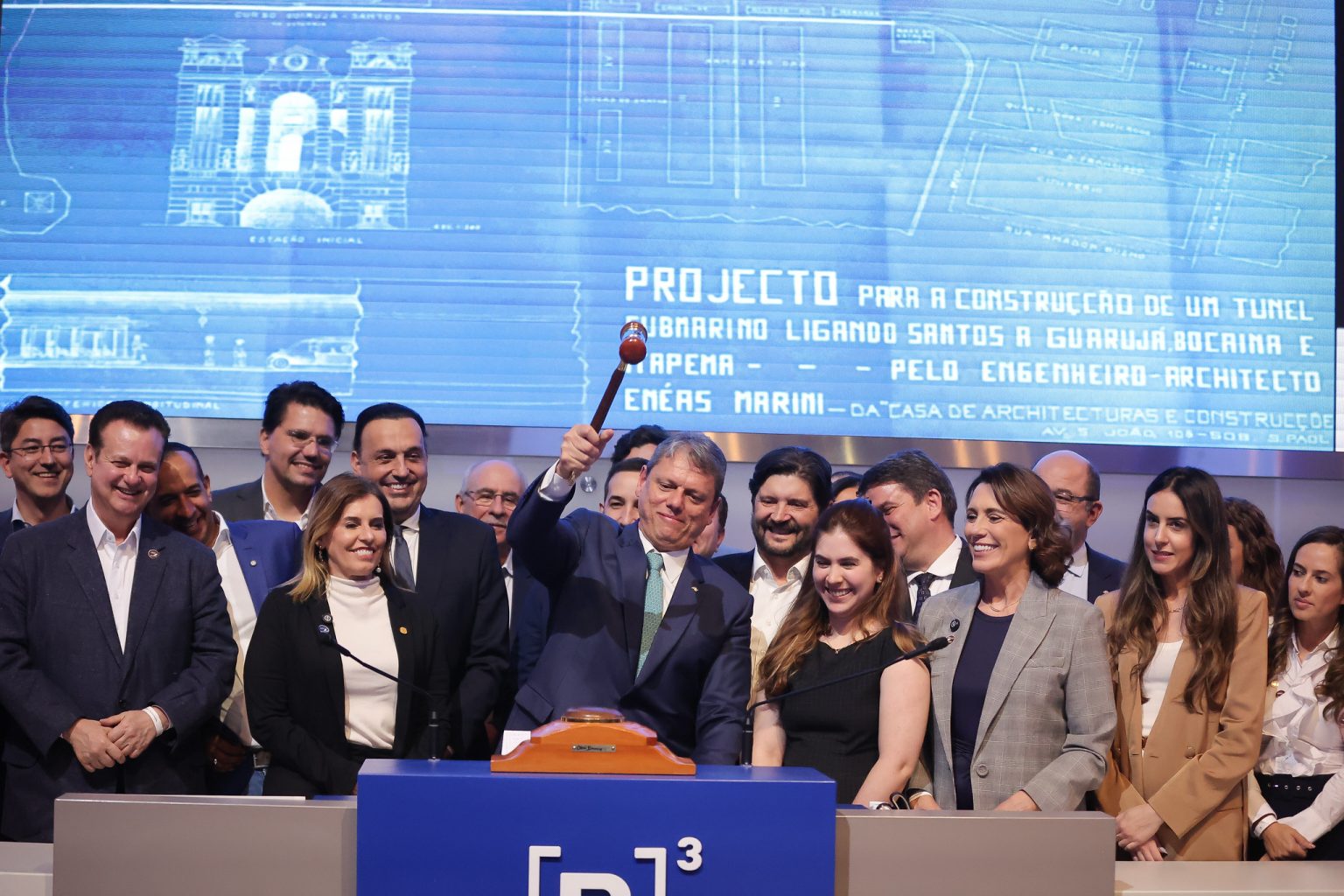
The Government of São Paulo, through the Secretariat for Investment Partnerships (SPI), held on Friday (5) at B3 in São Paulo the auction for the Santos–Guarujá Tunnel, one of the country’s most emblematic mobility projects. The winner was Mota-Engil Latam Portugal, with a proposal offering a 0.5% discount on the maximum annual public payment, set at R$ 438.3 million. Spanish company Acciona also participated, submitting a 0% discount offer.
“This is truly a historic day. It ends 100 years of waiting. Many people worked tirelessly to make this project a reality, with countless discussions and hours of effort. What we are celebrating today is the future of Baixada Santista, the state of São Paulo, and Brazil,” said Governor Tarcísio de Freitas.
With a total estimated investment of R$ 6.8 billion, the project will be carried out under a sponsored Public-Private Partnership (PPP) with a 30-year term. Public funding of up to R$ 5.1 billion will be provided, equally divided between the state and federal governments (R$ 2.5 billion each).
The tunnel will be 1.5 km long, with 870 meters immersed, built from pre-cast concrete segments installed on the seabed of the port channel — a technique widely used in Europe and Asia. The infrastructure will feature three lanes in each direction, one of which will be reserved for a Light Rail Vehicle (LRV), as well as pedestrian and bicycle crossings and a utility gallery. The multimodal design positions Baixada Santista at the forefront of future mobility, offering faster, more sustainable, and more inclusive transport solutions.
“The Santos–Guarujá Tunnel auction is a historic milestone for São Paulo and Brazil. We are delivering a modern engineering solution, with legal security and sustainability, that will shorten distances, create jobs, and transform mobility in the Baixada Santista,” highlighted Rafael Benini, Secretary of State for Investment Partnerships.
Currently, the connection between Santos and Guarujá is primarily made by ferries, which take an average of 18 minutes per crossing but can reach up to 1 hour due to queues and operational constraints. By road, travel time is also about 1 hour. With the tunnel, the journey will take just 5 minutes, directly benefiting more than 2 million residents of Baixada Santista and thousands of workers who commute daily between the cities.
“Today may seem like a single event, but it represents two and a half years of hard work. We’ve come this far, and I know there is still much to be done. I also know Artesp will closely monitor this project, demanding not only technical quality but also respect for the population. We are making a century-old dream come true,” said Raquel França Carneiro, Director of Artesp.
Immersed tunnel
The choice of the immersed tunnel method was based on a thorough technical analysis. Alternatives such as a bridge or a bored tunnel were discarded due to restrictions from the Santos Air Base, heavy ship traffic in the port channel, and the unstable soil in the area. The immersed solution ensures lower urban and environmental impact, fewer expropriations, and faster, safer execution.
The contract sets a reference toll of R$ 6.15 per direction for vehicles, similar to the current ferry fare. Pedestrians and cyclists will be exempt from payment, ensuring inclusive access.
“This is a project we have pursued for a long time. It will become essential infrastructure for São Paulo, the Port of Santos, and Brazil. We are confident we will meet our obligations and hope to start construction as soon as possible,” said Manuel António da Fonseca Vasconcelos da Mota, Vice President of Mota-Engil Latam Portugal.
The project is expected to generate around 9,000 direct and indirect jobs, along with training for local workers. It will directly benefit approximately 2 million residents of Baixada Santista, cutting travel time between Santos and Guarujá by up to 90% and strengthening logistical integration with the Port of Santos.
The project model was shaped through dialogue with the public and oversight bodies, resulting in route adjustments. In July 2025, CETESB issued a favorable technical opinion for the Preliminary License, confirming the project’s environmental viability.
The project was also presented during an international mission to Denmark, the Netherlands, and Norway, including a visit to the Fehmarnbelt Tunnel (Denmark–Germany) and meetings with global leaders in infrastructure engineering.