

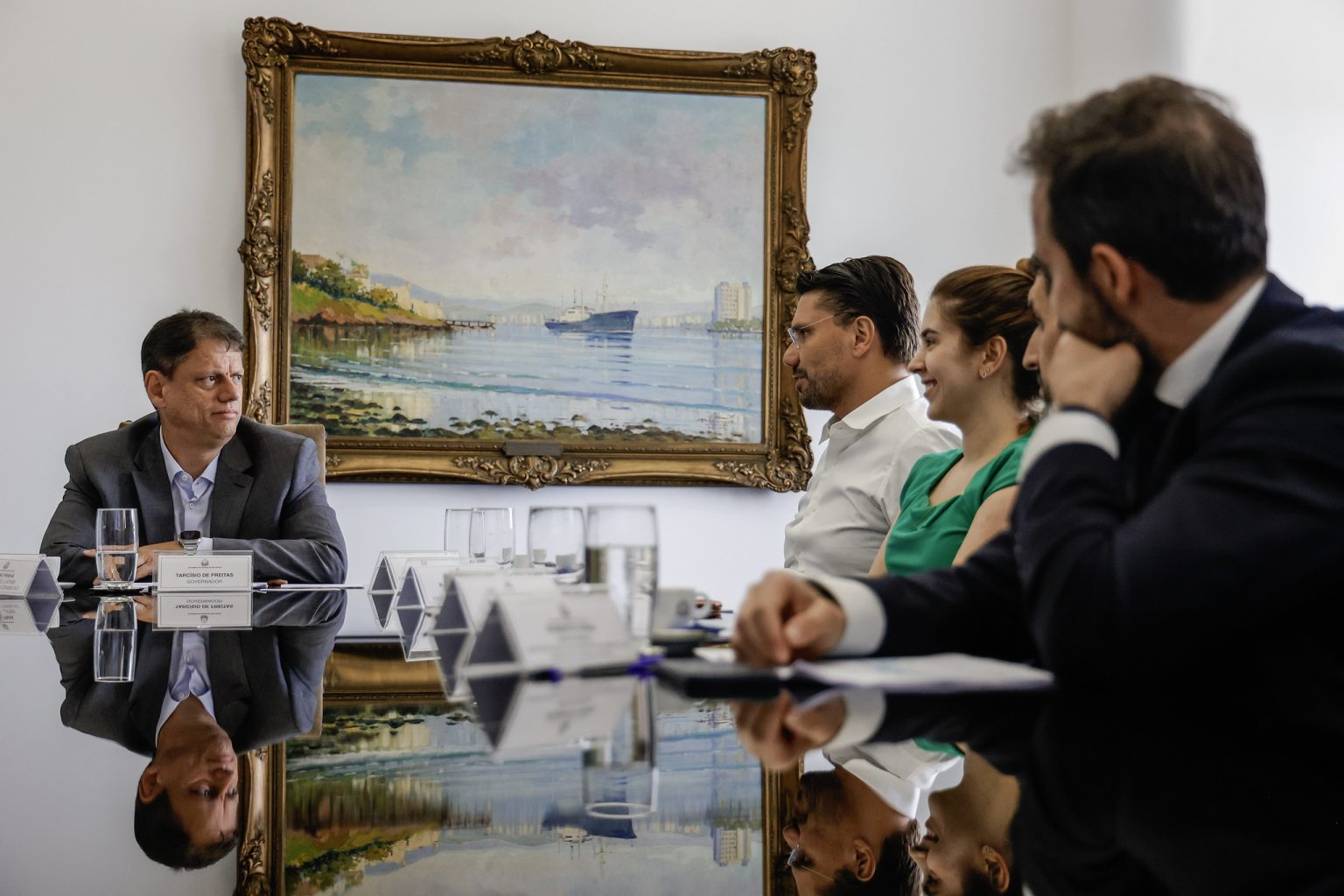
The Government of São Paulo signed, this Wednesday (28), the Public-Private Partnership (PPP) contract for the Santos–Guarujá Tunnel with the Portuguese group Mota-Engil. The agreement addresses a century-old demand in the Baixada Santista region and secures total investment of nearly R$ 7 billion in one of the largest infrastructure projects in the country. This will be Brazil’s first immersed tunnel, built from modules manufactured outside the channel and later submerged into the bed of the Port of Santos.
“We signed the contract with the Santos–Guarujá Tunnel concessionaire. What was considered impossible and awaited for 100 years will now become a reality. We will now begin discussions on the functional and executive designs. Next year, we will start mobilization and the beginning of construction. In 2028, we will begin manufacturing the elements—the six sections that will form the tunnel. In 2029, we will submerge these elements to assemble the tunnel, so that in 2030 the tunnel can be commissioned and delivered to the population,” said Rafael Benini, São Paulo’s Secretary for Investment Partnerships.
With total estimated investment of R$ 6.8 billion, the project includes the construction of an 870-meter tunnel beneath the port channel, with three lanes in each direction, pedestrian and cyclist passageways, and a service gallery. The 30-year contract also covers the operation and maintenance phases of the infrastructure.
The construction of the tunnel is expected to generate around 9,000 direct and indirect jobs, consolidating the project as a new pillar of urban and logistics development for the entire Baixada Santista. Travel time between Santos and Guarujá will be reduced to up to five minutes; today, the road connection between the two cities spans 40 kilometers and takes about one hour. Ferry crossings, meanwhile, are affected by weather conditions and ship traffic.
From auction to formal agreement
Mota-Engil won the auction held at B3 in September 2025, offering a 0.5% discount on the maximum annual public availability payment of R$ 438.3 million. The process can be followed on the official website (www.tunelsantosguaruja.sp.gov.br), which provides comprehensive information on the project, execution schedule, and progress of each phase, reinforcing the administration’s commitment to transparency and public access.
The preliminary environmental license has already been issued by Cetesb, certifying feasibility and authorizing progress to the next stages, ensuring predictability and legal certainty for the schedule. The assessment considered impacts on mangroves, fauna, flora, noise, and expropriations, establishing conditions to be met during the tunnel’s licensing phase.
In addition to the main structure, road interventions are planned in Santos and Guarujá to improve local traffic flow and prepare the cities for the new vehicle volumes. These complementary works are expected to begin as early as 2027, under the oversight of Artesp, the regulatory agency responsible for monitoring compliance with the schedule and ensuring transparency.
Next steps in the schedule
2026 – Functional and executive designs
Development of the functional and executive designs, completion of complementary studies, expropriation negotiations, and conduct of the environmental licensing required for project implementation.
2027 – Start of construction
Construction of the dry dock, execution of preliminary dredging, and installation of construction sites.
2028 – Manufacturing of elements
Precasting of tunnel sections, dredging of the trench in the port channel, and commencement of access ramps.
2029 – Immersion and assembly
Installation of tunnel elements, sealing of joints, and execution of access works.
2030 – Completion
Final finishes, installation of systems, and operational testing.