

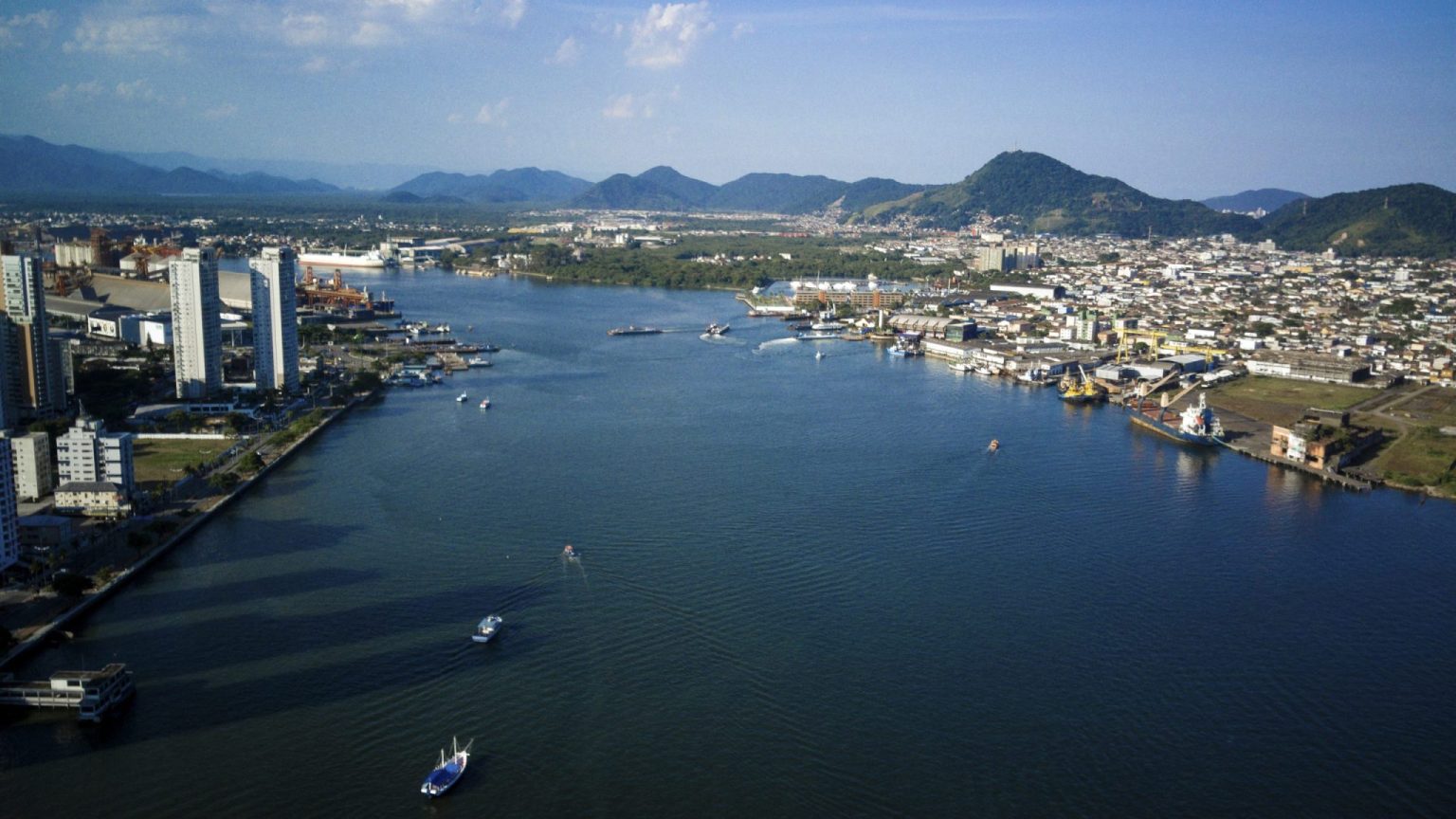
Brazil will have its first immersed tunnel, 870 meters long, built under the sea to connect the cities of Santos and Guarujá. Governor Tarcísio de Freitas is participating this Thursday (27), in Santos, in the launch of the concession notice for the Santos–Guarujá Tunnel. The project has an estimated investment of R$ 6 billion, to be shared between the State Government, the Federal Government, and the private sector, which will be responsible for the construction, operation, and maintenance of the tunnel.
The tunnel will be installed at a depth of 21 meters. A long-standing demand of the population, the project will reduce travel time between the two urban areas. Currently, the crossing is done by ferry or via a 40 km road route. More than 21,000 vehicles cross daily using small boats and ferries, along with 7,700 cyclists and 7,600 pedestrians. Watch the video
The tunnel will connect the neighborhoods of Outeirinhos and Macuco in Santos to the Vicente de Carvalho district in Guarujá. The project’s mobility study concluded that the most suitable location for the tunnel is at the center of the channel, meeting the region’s logistical needs.
The immersed tunnel project connecting the municipalities of Santos and Guarujá is qualified under the São Paulo State Partnership Program (PPI-SP) and will be executed through a public-private partnership (PPP), with an estimated investment of R$ 6 billion.
The future concessionaire will be responsible for building, operating, and maintaining the asset, which will support traffic for passenger vehicles, public transportation, trucks, bicycles (via a bike lane), and pedestrians. The project does not interfere with the development and expansion of the Port of Santos.
The studies were conducted by Fipe through the Companhia Paulista de Parcerias. The executive project was validated by two international consultancies specialized in complex engineering projects and already has a preliminary environmental license.

Current and future travel demand, connecting the main traffic-generating areas of the two cities in the Baixada Santista region, guided the design of the dry crossing proposal. The project will also allow for the integration of the region’s public transportation systems.
In addition to vehicle lanes, the tunnel will feature a pedestrian and bike path between six road lanes—three in each direction, with one lane adaptable for light rail (VLT).
The structure will be composed of six precast concrete modules built in a dry dock. These modules will then be submerged in water to test sealing and waterproofing. Once completed, the segments will be floated to the location where the tunnel will be installed on the seabed.

Project of the tunnel that will connect Santos and Guarujá
Construction stages:
Soil preparation
The first step is to prepare the canal bed where the tunnel will be installed. A trench is excavated to house the modules that will form the tunnel. Concrete slabs will be placed in the trench to support the tunnel elements.
Construction
The tunnel elements are concrete structures built in a dry dock, preferably near the final installation site. Each element includes temporary internal ballast tanks that initially prevent sinking.
Transport
Once the elements are ready, they undergo sealing and waterproofing tests. The dry dock is then flooded. Thanks to the temporary ballast, the tunnel elements float and are transported by tugboats to the installation site.
Positioning
The elements are secured to floating bridges and positioned using electronic systems at the exact location where they will be submerged.
Immersion
Water inside the ballast tanks is pumped out, allowing the tunnel elements to submerge slowly. This process is monitored by sensors.
Joining the elements
The elements are aligned using hydraulic winches until they are joined together.
Coupling
Final sealing between connected tunnel modules is achieved through the difference in atmospheric pressure between the installed segment and the new element being positioned.
Leveling
At one end of the segment, hydraulic jacks are anchored to move steel pins that level the module. Once aligned, the pins are welded and the jacks are removed. Sand is then injected under the module to form a bedding layer for final placement.
Protection
Finally, a layer of stones is placed over the tunnel to protect it from ship impacts and anchor dragging.
About the tunnel
Qualified under the São Paulo State Partnership Program (PPI-SP) and integrated into the Federal Government’s Growth Acceleration Program (PAC), the immersed tunnel project foresees a total investment of R$ 6 billion, with funding from the São Paulo State Government, the Federal Government, and private sector partners.

The concessionaire will be responsible for preparing the executive project and carrying out the construction of the tunnel and access roads, as well as the maintenance, preservation, and operation of the infrastructure for a 30-year period. Remuneration will come from tolls charged to users and, depending on the feasibility study results, from public payments during the operational phase.
The tunnel project is expected to solve one of the country’s biggest logistical bottlenecks.
The connection between the two main cities of the Baixada Santista will allow for the circulation of passenger vehicles, trucks, public transport, bicycles, and pedestrians in segregated lanes. The road solution also enhances the development and expansion potential of the Port of Santos.
With the executive project developed by the Government of São Paulo, the tunnel responds to a century-old demand of the Baixada Santista population and will significantly reduce travel time between the two municipalities.