

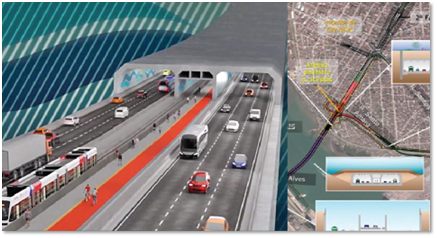
The São Paulo state government received on Monday, September 1, proposals from Spain’s Acciona and Portugal’s Mota-Engil for the execution of the Santos–Guarujá immersed tunnel project. The auction will be held on September 5 at the B3, São Paulo’s Stock Exchange. The names of the bidders for one of the largest and most complex infrastructure projects in Latin America were published in the official record on the website of the State Secretariat for Partnerships and Investments (SPI).
With an estimated investment of R$ 6.8 billion, the project will receive public funding of up to R$ 5.1 billion, split equally between the São Paulo state government and the federal government. The 30-year contract will cover construction, operation, and maintenance. The tunnel will be 1.5 km long, with 870 meters immersed, using pre-cast concrete segments installed on the seabed of the port channel — a technique already well established in Europe and Asia.
Unprecedented in Brazil, the project already has a preliminary environmental license issued by Cetesb in August 2025 and foresees integration between different modes of transport. It will feature three lanes in each direction, one of which will be reserved for a light rail system (VLT), along with a pedestrian walkway, a cycling path, and a service gallery. The multimodal design places the Baixada Santista region on the path to future mobility, offering faster, more sustainable, and more inclusive solutions.
Currently, the connection between Santos and Guarujá is made by ferries, which take around 18 minutes per crossing but are subject to queues and operational variability. By road, the journey can take up to an hour. With the tunnel, the trip will be completed in as little as 5 minutes, directly benefiting more than 720,000 residents of the two cities and the thousands of workers who commute between them daily.
In addition to reducing travel time, the tunnel will boost tourism, strengthen the local economy, and contribute to reducing emissions by encouraging collective and sustainable modes of transport.