

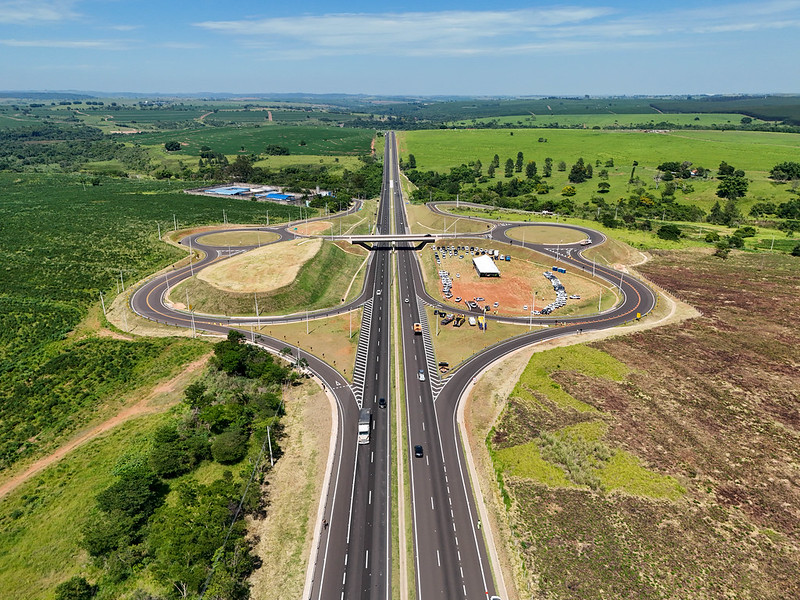
The Rota Mogiana concession will raise road safety standards along key corridors in the countryside of São Paulo through a combination of infrastructure works, structural improvements, and the adoption of internationally recognized methodologies.
The project is structured by the Government of São Paulo through the Secretariat of Partnerships and Investments (SPI) and includes interventions along 520 kilometers of highways, consolidating an important regional integration corridor that connects the Campinas Metropolitan Region to Ribeirão Preto and municipalities along the border with Minas Gerais.
The auction was held last Friday (February 27) at B3 in São Paulo. The Rota Mogiana consortium, led by the Azevedo & Travassos group, was declared the winner after offering the highest fixed grant payment to the State, totaling R$ 1.08 billion.
Among the guidelines set in the bidding notice is the requirement for the future concessionaire to adopt the iRAP (International Road Assessment Programme) methodology, a global reference in road safety evaluation and management. Used in dozens of countries, iRAP has already assessed more than 1.3 million kilometers of roads worldwide and systematically guides the implementation of strategic interventions to reduce accidents and improve traffic safety.
The methodology is based on four essential protocols: risk mapping, performance monitoring, star rating classification, and the development of investment plans to make roads safer. Each evaluated section receives a rating from one to five stars according to the level of risk it presents to users.
The criteria are based on evidence that helps identify risks and plan improvements through detailed mapping and continuous performance monitoring. The star-rating system allows investments and interventions to be prioritized based on their impact on improving safety along each road segment.
The Rota Mogiana project also includes highway duplication, implementation of additional lanes, shoulder improvements, construction of pedestrian overpasses, and modernization of access interchanges. Specific safety interventions are also planned, including installation of barriers and guardrails, rumble strips in high-traffic sections to alert drivers, and modernization of road signage and lighting, particularly at critical points.
Another highlight is the construction of a new bypass in Águas da Prata, designed to remove heavy traffic from the urban stretch of SP-342, reducing impacts on the local population and improving traffic flow along the corridor.
With estimated investments of R$ 9.4 billion over 30 years, the Rota Mogiana concession also includes the implementation of the electronic tolling system Siga Fácil, which eliminates mandatory stops and contributes to smoother and safer traffic. The bidding notice was republished to consolidate technical adjustments and strengthen contractual security while maintaining the project’s scope of works.
Toll reduction
The new concession, which will combine stretches currently managed by Renovias with highways administered by DER, is scheduled to begin in July 2026, when the current contract expires. From the outset, toll rates at existing plazas will be reduced. In Jaguariúna, tolls will drop by up to 29%. There will also be reductions of 27% in Águas da Prata, 26% in Estiva Gerbi, and 20% in Espírito Santo do Pinhal and Itobi, as well as reductions in Casa Branca (13%), Mococa (9%), and Aguaí (5%). As a result, most existing toll plazas will see immediate reductions in base toll rates at the start of operations. The measure is part of the State’s policy of standardizing per-kilometer toll rates, ensuring lower per-km charges and greater fairness for users.
Siga Fácil
Siga Fácil (www.sigafacil.sp.gov.br) is the system implemented by the Government of São Paulo that replaces traditional toll plazas with intelligent electronic gantries capable of identifying vehicles by license plates or tags, making the process faster, more efficient, and fairer. Under Siga Fácil, drivers pay only for the distance traveled. Supervised by the São Paulo State Transport Agency (Artesp), the system eliminates queues and reduces accidents.
The system will be gradually implemented in the most recent concession projects, such as Novo Litoral Paulista, Nova Raposo, and Rota Sorocabana, as well as in existing contracts. The website sigafacil.sp.gov.br provides maps of gantries, payment methods, and customer service channels.
SP pra Toda Obra
The project is part of the SP pra Toda Obra program, an initiative of the Government of São Paulo that includes improvements to 21,200 kilometers of highways managed by the São Paulo State Department of Highways (DER-SP) and concessionaires, under the supervision of Artesp. The R$ 30.5 billion investment is the largest in the State’s history in this sector.