

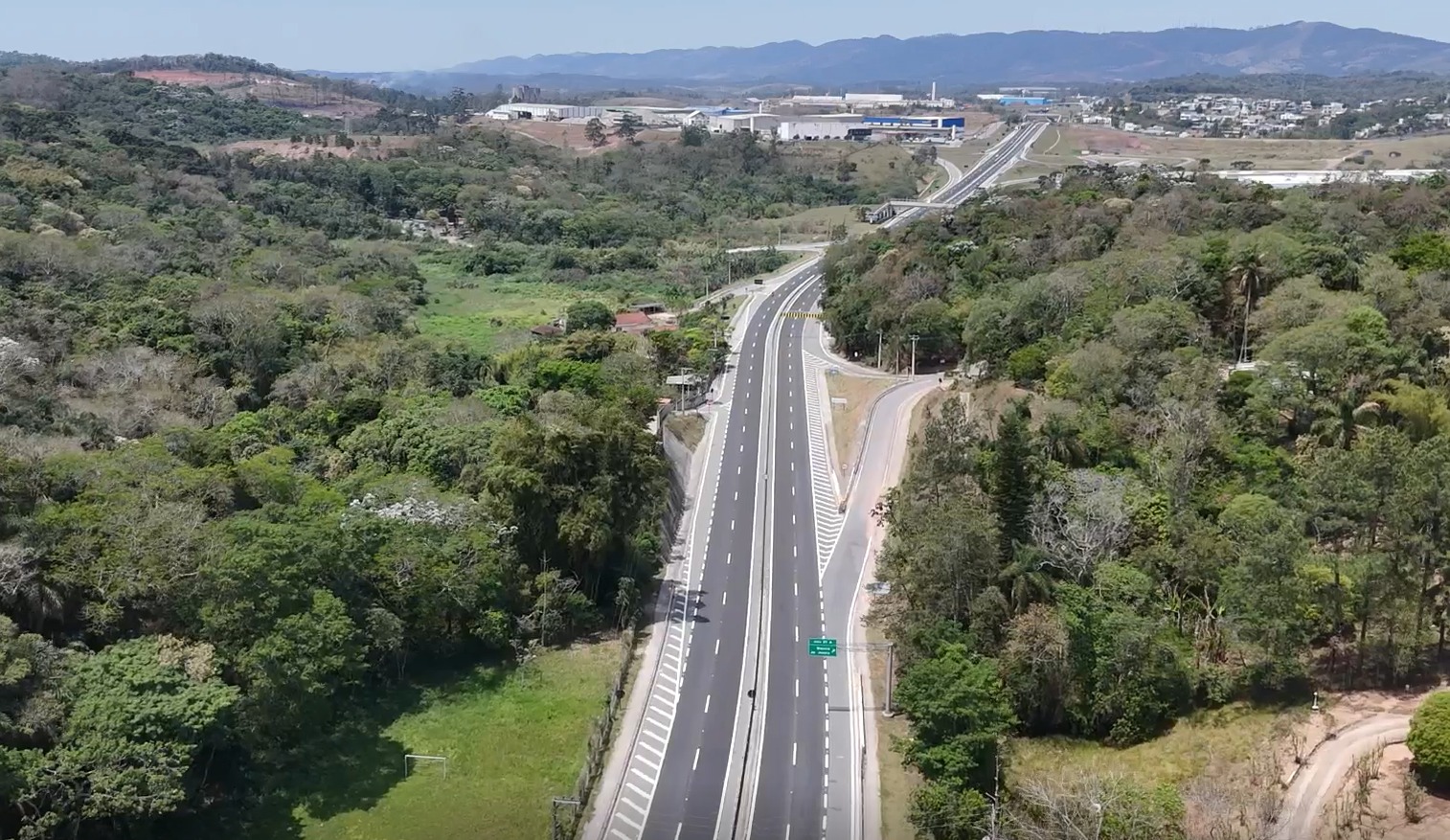
The Government of São Paulo is enhancing safety and traffic flow in the Alto Tietê region with a new package of improvements along the Mogi-Dutra Highway (SP-088). The works include duplications, additional lanes, and new frontage roads, measures that will help reduce congestion and make travel safer for drivers and pedestrians.
The plan provides for the duplication of eight kilometers between Arujá and Mogi das Cruzes, at the junction with the Presidente Dutra Highway (SP-060), as well as the construction of 19 kilometers of additional lanes on uphill sections to improve heavy-vehicle flow and increase overall traffic capacity. To reinforce safety, seven new interchanges will be built, eliminating at-grade crossings.
In Mogi das Cruzes, a one-kilometer frontage road will be constructed to improve local mobility, reduce congestion, and facilitate urban traffic during peak hours. The package also includes seven new pedestrian overpasses and 14 new bus stops along the urban section of the highway.
Investments
In this initial phase, the interventions focus on works and services that enhance safety, comfort, and efficiency standards for users. Improvements include the rehabilitation of 212 kilometers of pavement and upgraded horizontal and vertical signage, with the replacement of 4,193 traffic signs, installation of 3,000 meters of anti-glare fencing, and replacement of 3,060 meters of guardrails.
New LED lighting is also being installed in several urban stretches, along with drainage and containment improvements. The modernization plan includes CCTV monitoring and connectivity upgrades to ensure a safer and more efficient road network. Maintenance teams have carried out vegetation clearing over 14 million square meters—an area nearly ten times the size of the city of São Paulo—and revitalized 17,180 meters of fencing.
Teams based at the eight new User Service (SAU) stations and 30 dedicated response vehicles have already conducted over 45,000 roadside assists, including 28,497 road inspections, 11,389 vehicle removals, 1,267 mechanical assists, 2,715 medical responses, and more than 800 animal removals, enhancing protection for motorists and pedestrians.
With a R$ 4.3 billion investment package, the improvements are advancing toward new stages, focusing on major structural works. One of the highlights is the duplication of 90 kilometers—representing 42% of the entire 212-kilometer concessioned network. The package also includes the construction of new frontage roads, bike lanes, and pedestrian overpasses, along with the complete resurfacing of the concessioned stretch.
Siga Fácil
The significant investments made during the first ten months of operation precede the implementation of Siga Fácil, the São Paulo government’s new system that replaces traditional toll plazas with intelligent electronic gantries. The gantries identify vehicles through license plates or tags, making toll collection faster, fairer, and more efficient.
Supervised by the São Paulo State Transport Agency (Artesp), the system eliminates queues, reduces accidents, and, in concessions signed from 2024 onward, charges tolls proportionally to the distance traveled. Siga Fácil will be gradually implemented in the state’s newest concession projects — including Novo Litoral Paulista, Nova Raposo, and Rota Sorocabana — as well as in existing contracts.