

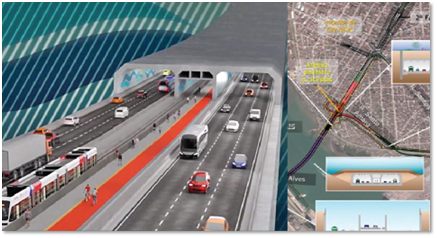
At least three projects led by the Government of São Paulo in the Baixada Santista will transform mobility, bringing more comfort, speed, and safety to the population. At the forefront is the construction of the Santos–Guarujá Tunnel, a long-awaited demand of the region’s residents. The auction will be held this Friday (5), at 4 p.m., at the São Paulo Stock Exchange (B3).
With an estimated investment of R$ 6.8 billion, the Santos–Guarujá Tunnel will receive up to R$ 5.1 billion in public funding, split equally between the São Paulo state government and the federal government. The 30-year contract will cover construction, operation, and maintenance. The tunnel will extend 1.5 km, with 870 meters immersed, using prefabricated concrete modules installed on the seabed of the port channel — a technique already widely used in Europe and Asia.
Currently, the connection between Santos and Guarujá is made by ferries, which take about 18 minutes per crossing but are subject to queues and operational variations. By road, the journey can take up to an hour. With the tunnel, the trip will take no more than 5 minutes, directly benefiting about 2 million residents of both municipalities and workers who travel daily between the two cities.
In addition to cutting travel time, the tunnel — linking the neighborhoods of Outeirinhos and Macuco, in Santos, to Vicente de Carvalho, in Guarujá — will boost tourism, strengthen the local economy, and contribute to reducing emissions by encouraging collective and sustainable modes of transport.
coastal lot
The highways of the coastal lot, connecting municipalities in Alto Tietê (Greater São Paulo) to the Baixada Santista and Vale do Ribeira, are undergoing a major package of improvements following the concession granted by the Government of São Paulo in 2024. The works are carried out by concessionaire Novo Litoral (CNL), under the supervision of São Paulo’s Transport Agency (Artesp).
Currently, there are 35 active work fronts, carrying out services ranging from enhanced signage and road cleaning to pavement works and preparation for major structural interventions. The goal is to modernize the highway network and ensure greater safety and comfort for drivers.
Altogether, 212 kilometers of highways will be modernized, with investments totaling R$ 4.3 billion. The plan includes full duplication of the Padre Manoel da Nóbrega highway (SP-055), from Bertioga to Santos and from Peruíbe to Miracatu, as well as the construction of 108 kilometers of marginal lanes with lighting and sidewalks. The package also includes 27 grade-separated interchanges, 22 kilometers of shoulders, new bike lanes, and pedestrian overpasses.
Other roads to be improved include Professor Alfredo Rolim de Moura (SP-088) and Dom Paulo Rolim Loureiro (SP-098), in addition to integration with Dom Pedro I highway (SP-065) and the future duplication of the Bertioga–Santos stretch.
Since November 2024, more than 30 patrol vehicles have strengthened highway policing, increasing safety for drivers and pedestrians. Eight new user service centers (SAUs) are also already operational, along with improved signage, vegetation control, and lighting. Modernization efforts also include CCTV monitoring, connectivity, and reinforced roadway safety features, aiming to provide a safer, more modern, and functional standard of urban and regional mobility without disrupting the daily lives of Baixada residents.
Imigrantes’ third lane
The construction of a third lane on the Imigrantes highway will allow truck traffic toward the coast, which today is restricted to the Anchieta highway. Studies for the implementation of the lane were authorized earlier this year. The Anchieta–Imigrantes System’s capacity will increase by 25% overall and by 145% for heavy-vehicle traffic heading downhill. The project will meet current traffic demand and accommodate future increases in flow.
The project calls for a new 21.5 km lane along the mountain stretch, consisting mainly of tunnels — totaling 17 km (80% of the route) — and 4 km of viaducts. One of the tunnels will be about 6 km long, becoming the largest of its kind in Brazil. The new lane will have two traffic lanes and a shoulder that can be converted into a third lane.
The structure will start at km 43 of the Imigrantes highway (SP-160), allowing access from the Mario Covas Beltway (SP-021). In the Baixada, the connection will be at km 265 of the Cônego Domênico Rangoni highway (SP-055), near the Cubatão Industrial Hub. It will also provide quick access to both the right and left banks of the Port of Santos.