

The Government of the State of São Paulo authorized on Monday (10), during a meeting of the Council of the São Paulo State Partnership Program (PPI-SP), the preparation of studies for the expansion of Orange Line 6, one of the main metro projects in the capital. At the same meeting, the final modeling for the Santos–Guarujá Tunnel was also formally approved.
“We are advancing in another major mobility project for São Paulo. The expansion of Orange Line 6 means more integration, efficiency, and comfort for the population, ensuring high-quality public transportation planned for the future,” emphasized Governor Tarcísio de Freitas.
The meeting included the presence of Governor Tarcísio de Freitas, Secretary for Partnerships in Investments Rafael Benini, Chief Secretary of the Civil House Arthur Lima, Finance Secretary Samuel Kinoshita, State Attorney General Inês Coimbra, and Secretary for Environment, Infrastructure and Logistics Natália Resende.
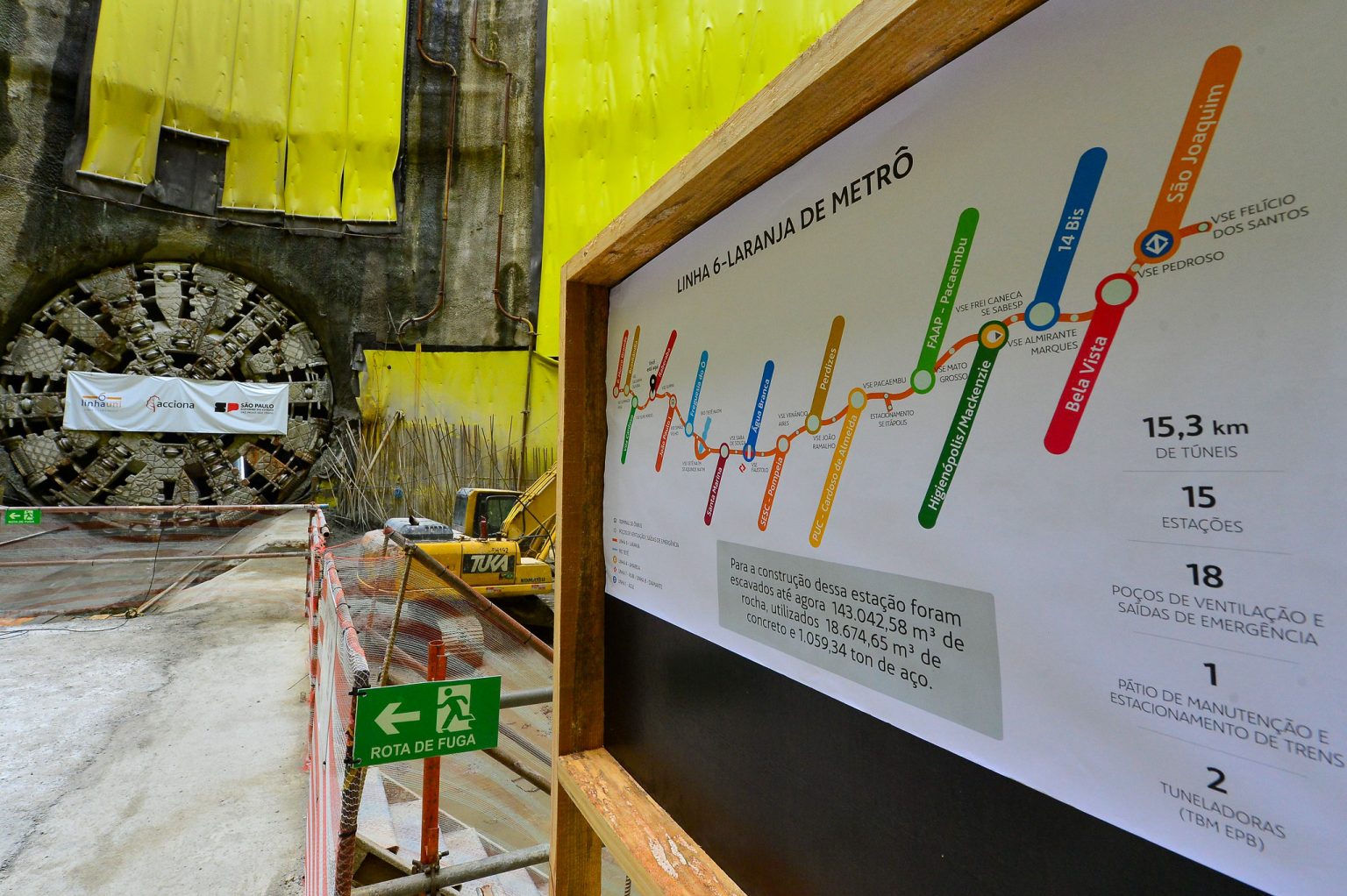
Orange Line 6
The expansion of Orange Line 6 foresees the construction of an additional 7 km of tracks and six new stations, enhancing integration among different transportation modes and improving passenger flow. The project will be executed in two segments: one heading toward the central region, with new stations Aclimação, Cambuci, Vila Monumento, and São Carlos, and another toward the North Zone, which will include stops at Morro Grande and Velha Campinas.
The work will employ different excavation methods based on the local soil geology. In the central segment, a Tunnel Boring Machine (TBM)—known as Tatuzão—will be used, a technology that allows tunnel excavation with minimal surface impact. The extension toward the North Zone will adopt the New Austrian Tunneling Method (NATM), better suited for rocky soils.
“The expansion of Orange Line 6 reinforces the Government of São Paulo’s commitment to urban mobility, bringing more integration and efficiency to public transportation. An extra 7 km of tracks and six new stations will benefit thousands of passengers daily,” said Rafael Benini, Secretary for Partnerships in Investments.
With this expansion, Orange Line 6 will connect directly with Line 10–Turquoise, making metropolitan transportation more efficient. The concessionaire responsible for the university line will conduct the feasibility studies and obtain the necessary permits. After this phase, the State Government will assess including the expansion in the concession contract as an additional investment.
Santos–Guarujá Tunnel
The tunnel project, qualified under the São Paulo State Partnership Program (PPI-SP) and integrated into the Growth Acceleration Program (PAC), is estimated at R$ 6 billion and had its final modeling approved during the meeting. The cost will be shared among the Government of São Paulo, the Federal Government, and the private sector. Construction is expected to generate around 9,000 direct and indirect jobs.
With the executive project developed by the Government of São Paulo, the tunnel meets a long-standing demand of the Baixada Santista population and will significantly reduce travel time between the two municipalities. Currently, over 21,000 vehicles cross daily by small boats and ferries, in addition to 7,700 cyclists and 7,600 pedestrians.
The total structure will be 1.5 km long, with 870 meters submerged. The tunnel will feature three lanes in each direction, one of which is dedicated to light rail (VLT), and will include exclusive access for pedestrians and cyclists.
State Partnership Program (PPI-SP)
PPI-SP is an initiative of the Government of the State of São Paulo aimed at expanding opportunities for investment, employment, and socioeconomic, technological, environmental, and industrial development in São Paulo. Focusing on highways, mobility, social development, and water/energy, PPI-SP is implementing the largest and most comprehensive private investment program in the history of São Paulo, benefiting the population and driving regional economic growth. To date, 29 projects have been qualified, representing a portfolio of more than R$ 494 billion.