

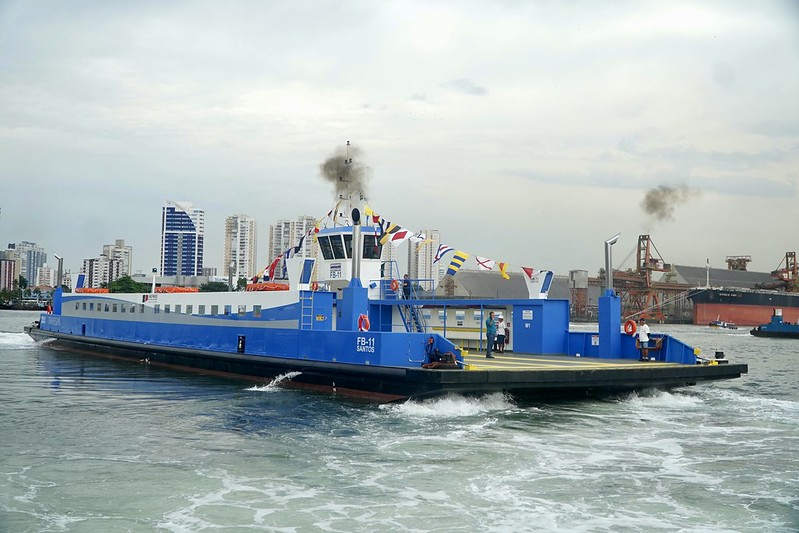
Governor Tarcísio de Freitas has sanctioned the law authorizing the concession of the water crossings system to the private sector. Approved last week by the Legislative Assembly (Alesp), the measure will allow the modernization of the water transport service for passengers and vehicles in different regions of the state. The sanction will be published in this Wednesday’s (23rd) edition of the Official Gazette of the State of São Paulo.
“We’re going to provide quality transportation for the population that relies on ferries and boats to get around, as well as making life easier for visitors to regions with huge tourist potential. We are transforming people’s daily lives and attracting economic growth every time we get these projects off the ground. Nothing can resist investment,” says Governor Tarcísio de Freitas.
The initiative paves the way for an investment of R$1 billion in the modernization of 14 ferry and boat routes, which serve around 40,000 people a day. Among the improvements is the acquisition of more than 40 new vessels, including electric models to increase climate resilience, and the improvement of infrastructure and terminals.
To present the project to international investors, Governor Tarcísio de Freitas is holding a roadshow this week in countries such as Denmark, the Netherlands and Norway. In addition to the crossing system, other initiatives qualified under the state’s investment partnership program (PPI-SP), such as the Santos-Guarujá immersed tunnel, are also on the agenda.
The first stop for the São Paulo delegation was Amsterdam, where they met with executives from the Ballast Nedam construction company. Over the next few days, Governor Tarcísio de Freitas will meet with leaders of companies such as TEC Tunnel, Immontec, Ruter, LNS, Sweco, DFDS, Maersk and Femern A/S in the Netherlands and also in Norway and Denmark.
The mission will also make a technical visit to the Fehmarnbelt underwater tunnel, under construction between Denmark and Germany. With a length of 18 kilometers, four lanes of road and two railway lines, the mega-structure is considered a global benchmark and serves as an example for the Santos-Guarujá Tunnel project.
Photo: Sergio Barzaghi / SP State Government